Abbey of San Michele
Kraak! Right in the heart of Terra Murata — the medieval village, meaning the oldest and fortified part of the island — you’ll find one of Procida’s most important places: the Abbey of San Michele Arcangelo. It stands at the center, like a ship anchored between stone and sky.
Criii! The abbey was built by the Benedictines in the 11th century, and later, in the second half of the 15th century, it was entrusted “in commendam” to cardinals — meaning it was managed by high-ranking clergy without them living here permanently. A long story, like the wind circling the walls.
Squa-squa! The building follows a basilica layout — a church with internal aisles — and is arranged on two levels: the upper level hosts the church, while the lower level includes the abbey complex, which itself develops over three levels. Can you imagine how many lives have passed through here?
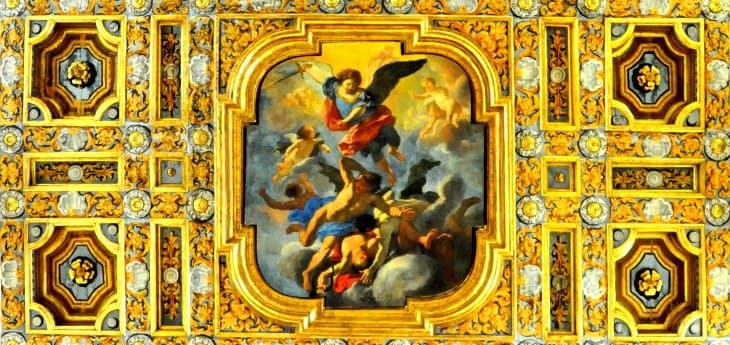
Kraak! Inside, you’ll find three aisles. The central one is covered by a coffered ceiling in wood and pure gold, shining like sunlight on the sea, with a 17th-century painting at its center depicting Saint Michael defeating Satan. A powerful image that seems to move the air itself.
Criii! Every corner here holds time. There are seventeen altars, a 17th-century wooden choir in the central apse — the curved space behind the altar — and four paintings by the Neapolitan artist Nicola Russo from 1690, including one depicting the 1535 event when Saint Michael protected the island of Procida from the Saracens.
Squa-squa! At the entrance, on the left, you’ll see the ancient baptistery. Along the left aisle, there is the painting of the Dormitio Virginis, dating between the late 16th and early 17th century. You’ll also find the statue of Our Lady of Mount Carmel in wood and gold, and the silver statue of Saint Michael, both placed in chapels along the same aisle.
Kraak! In the third chapel, there is a reconstruction of the Grotto of Lourdes. And to the right of the main entrance, the painting of the “Judgment of Saint Lucy before the Tyrant of Syracuse”. Did you know every piece here is like a sail telling a story?
Criii! In the transept — the part that crosses the church horizontally — you’ll find the relics of Saint Porfirio Martyr, a Saracen anchor, and an 18th-century bellows organ. Beneath your feet, a marble floor from the 18th century that feels like frozen waves.
Squa-squa! And below it all, in the underground (currently not open to visitors), lies a Museum Complex across three levels: a permanent nativity scene with 18th-century Neapolitan figures, a library created in the late 16th century by Cardinal Innico d’Avalos d’Aragona, and finally an ossuary, still visible, accessible through trapdoors. A hidden world, like the sea beneath a hull.
Arturo is just a seagull, so take what he says with a grain of salt and always double-check the facts.
If you find any errors or have any updates, please help us by writing to procidaislandapp@gmail.com