Terra Murata
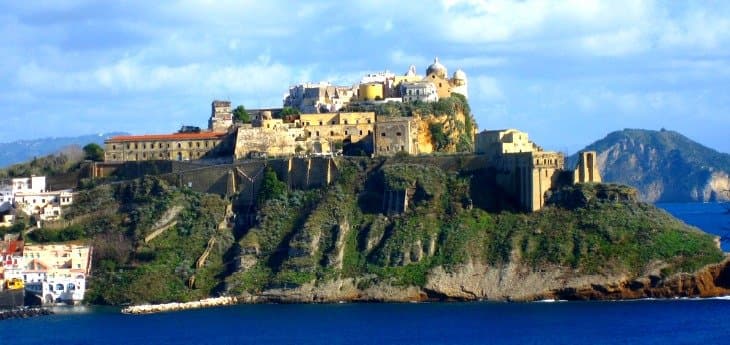
Kraak! Listen up, because what I'm about to tell you is the beating heart of Procida — the place I, Arturo, fly over every single day with more pride than anywhere else.
Start from Piazza dei Martiri, known to the locals as Semmarezio, and let yourself be carried up by a short but steep climb — a little challenge the island throws at you before revealing its most beautiful secrets. The destination is Terra Murata, the medieval fortified citadel that rises at the highest point of the island, dropping straight down to the sea below. Yes, right up there, where the wind always knows which way it's blowing.
But even on the way up, at a bend in the road, the island stops you in your tracks. Squa-squa! Spread out before you is the most iconic landscape in Procida: Marina Corricella, with its stacked, multicoloured houses cascading down toward the sea like an open-air amphitheatre facing the blue. Friendly, warm-hearted fishermen live here — people I know well, I watch them pull in their nets every morning. It's no surprise this place has been chosen as a natural film set and backdrop for commercials: it's a real postcard, not a manufactured one.
Continuing eastward, your eye catches the silhouette of the Dominican Convent of Santa Margherita Nuova, built between 1586 and 1956. To raise it on that steep rocky cliff, a system of pillars topped with arches had to be constructed — a structure that today defines the most distinctive feature of Punta dei Monaci. Every time I glide over it, it reminds me how the people of this island have always known how to reckon with rock and sea.
Keep going and you reach the Piazza d'Armi. On one side, tall buildings that once served as a stronghold for the local people against invading enemies. On the other, the Royal Palace, built in 1563 by Cardinal Innico d'Avalos d'Aragona, Abbot of San Michele. Real history, real stone.
Criii! At the centre of the square, a short climb leads you to three things you simply cannot miss. The first is the Conservatory of Orphans, now the Palace of Culture, founded in 1656 to shelter victims of the plague — a place that carries centuries of humanity within its walls. The second is a breathtaking sea view, the kind that makes you understand why people never stop coming back to Procida. The third — and most important — is the Abbey of San Michele, the island's principal historic building, dating back to the sixteenth century.
Did you know it was originally a Benedictine monastery, founded between the seventh and eighth centuries? Over the centuries it was repeatedly ransacked, destroyed and rebuilt because of Saracen raids — the pirates who once roamed these waters. Today it houses numerous works of art, including a painting of Saint Michael, from the school of Luca Giordano, set at the centre of a magnificent coffered ceiling. It's worth every single step of the climb, trust me.
And then there's the village itself — gentle, serene, home to quiet, unhurried people. Its narrow lanes are like alleyways: a constant coming and going of passages, corridors and covered streets. Doors open onto stairways, windows, and wells still full of water. One of these lanes is Via Concetta Barra, named on 3 September 2001 after the multifaceted artist born right here in Procida — a heartfelt tribute, one the island's people truly wanted.
Kraak! What makes this place truly special is something you can't see but can only feel: a sense of stillness and quiet solitude — in the best possible way, the kind where time moves differently, far from the noise of the world. Come and breathe it in. I'll be there waiting for you, gliding above the rooftops of Terra Murata.
Arturo is just a seagull, so take what he says with a grain of salt and always double-check the facts.
If you find any errors or have any updates, please help us by writing to procidaislandapp@gmail.com