San Michele Arcangelo
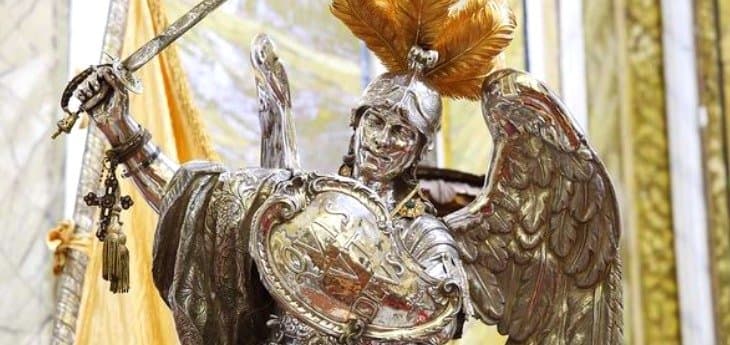
Kraak! We have arrived at the most important place on all of Procida. In the heart of the medieval village of Terra Murata stands the Abbey of San Michele Arcangelo — the oldest and most precious historic building on the island.
It was built by the Benedictines in the eleventh century — the year one thousand — and in the second half of the fifteenth century it was entrusted in commendam to cardinals, who became its custodians and patrons. The building is arranged on two levels: the upper floor houses the church, while the lower floor contains the abbey complex, itself spread across three levels. Criii!
You step inside, and the first sight leaves you speechless. The church has three naves, and the central one is covered by an extraordinary coffered ceiling in wood and pure gold — a decorative grid of gilded panels that shimmer like the sea in sunlight. At its centre hangs the painting depicting Saint Michael defeating Satan, created in the seventeenth century. A vision that, even for a seagull accustomed to flying high, takes the breath away.
The treasures housed inside are of rare richness. Squa-squa! Here are the highlights. Seventeen altars mark out the sacred space. In the central apse stands a seventeenth-century wooden choir. Four paintings by the Neapolitan artist Nicola Russo, made in 1690, tell the story of the island — among them the canvas depicting the event of 1535, in which Saint Michael the Archangel protected Procida from the Saracens.
To the left of the main entrance stands the ancient baptistery. In the left nave, the first altar holds the painting of the Dormitio Virginis — the death of the Virgin — dating from the late sixteenth to early seventeenth century. Further along, in the chapel of the same name, the wooden statue of the Madonna del Carmine in pure gold, and in the Chapel of San Michele the precious silver statue of Saint Michael the Archangel. The third chapel of the left nave houses a reconstruction of the Grotto of Lourdes. Kraak!
And there is more. To the right of the main entrance, the canvas of the "Trial of Saint Lucy before the Tyrant of Syracuse ". In the transept — the cross arm of the church — the Relics of Saint Porphyry Martyr kept in the Chapel of the Holy Spirit, and a remarkable Saracen anchor, a silent witness to the battles fought on these waters. Completing the collection are an eighteenth-century bellows organ and a magnificent eighteenth-century marble floor.
Beneath the Abbey — currently not open to visitors — lies a Museum Complex spread across three levels. The first houses a permanent Nativity scene with eighteenth-century Neapolitan-school figurines. The second holds a library created in the mid-sixteenth century by Cardinal Innico d'Avalos d'Aragona. The final level contains the ossuary, accessible through trapdoors that are still visible today. Criii! A place that carries within it layer upon layer of history, art and devotion. Don't miss it.
Arturo is just a seagull, so take what he says with a grain of salt and always double-check the facts.
If you find any errors or have any updates, please help us by writing to procidaislandapp@gmail.com